
The First Signal in Digital Marketing: Where Attention, Trust & Clarity Begin
Every creative journey in digital marketing begins quietly. Not with a breakthrough idea, but with small survival decisions made under pressure. Tight deadlines, shrinking attention spans and platforms that reward speed over reflection often shape these moments. When time is limited, creators and marketers rarely experiment. They optimize. They fall back on what feels familiar, safe and fast.
In today’s 360° digital marketing landscape, these instinctive choices carry real weight. Research shows that users form a visual impression of content in less than 50 milliseconds. Long before a message is consciously understood, the brain reacts to structure, contrast and balance. This kind of foundational thinking is emphasized in serious digital marketing learning environments, where clarity and performance matter as much as tools. In digital spaces, especially on scroll-heavy platforms like Instagram & Facebook, how something looks is processed before what it says, quietly shaping brand perception.
This reality defines modern 360° digital marketing. Tools and platforms matter, but performance is increasingly decided by clarity. How quickly information is understood, how comfortable it feels to engage with and how smoothly attention flows through content now determine outcomes.
Where Attention Takes Shape
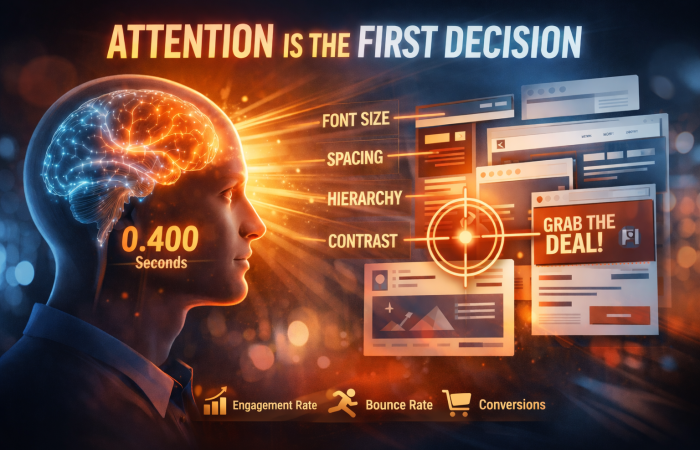
Attention is the starting point of all digital marketing outcomes. Before engagement, before clicks and before conversion, there is a brief window where content is either understood or ignored.
Typography plays a decisive role in that moment. Neuroscience studies show that the brain begins evaluating visual input in under 400 milliseconds. Letter spacing, alignment, hierarchy and contrast directly influence scanning speed and comprehension. These details affect measurable outcomes such as engagement rate, bounce rate and conversion.
In a 360° digital marketing ecosystem where content appears across websites, landing pages, ads, presentations and social media marketing platforms, typography acts as a stabilizing system. It maintains clarity even as formats change. This is why effective SEO optimization today goes beyond keywords. Readability, structure and user experience are now inseparable from search performance.
In professional training environments, typography is increasingly treated as a functional skill rather than a decorative choice. The reason is simple. In fast-moving digital spaces, users scan before they read. If hierarchy is unclear or text feels visually dense, attention collapses instantly. Clarity is not optional. It is essential.
Trust Is Built Before Meaning
Trust online is formed quietly and almost instantly. Users compare brands constantly, often without realising it. Studies show that nearly 75 percent of users associate visual clarity with brand credibility.
Typography plays a central role in this judgement. Structured, well-balanced text signals professionalism and reliability. Inconsistent or chaotic typography introduces doubt, even when the message itself is strong. This matters most on social platforms, where legitimacy is assessed in seconds.
Typography also shapes emotional response. Certain structures feel calm and reassuring, while others feel urgent or distant. These emotional cues influence how long users stay, how much they read and whether they engage further. Familiar visual patterns reduce cognitive load, making content feel easier even when the information is complex.
From an SEO optimization perspective, this connection is critical. Search engines increasingly reward content that users spend time with. When typography supports comfort and clarity, dwell time improves. This strengthens both user trust and search visibility.
The Fonts That Perform and Why
Typography works best when it is treated as a system rather than a creative mood. Over time, certain fonts have proven to be consistently reliable across platforms and use cases.
Clean, modern typefaces such as Inter, Roboto, Montserrat and Quicksand perform well for body text, interfaces, presentations and long-form content where readability is non-negotiable. Condensed and structured fonts like Oswald, Bebas Neue, Roboto Condensed, Donau and Century Expanded are effective for headlines, banners, thumbnails and carousels. These are spaces where attention must be captured within seconds.
Display fonts including Cinzel, Playfair, Stoic, Intro Rust, Sailors, Nickainley and Hey Gotcha add personality to logos and hero sections, where emotional impact matters more than restraint.
Fun fact: The average user reads only 20 to 30 percent of the text on a page. Typography’s real job is not to make content look impressive. Its job is to guide the reader’s eyes so the right information is absorbed before attention drifts away.
Typography is just one piece of the digital marketing puzzle. Understanding why it works, and how to apply it across platforms, is what separates designers from strategic digital marketers.
Explore 360° Digital Marketing at East India’s best Digital Marketing Institute.
Consistency That Compounds
Consistency in typography builds recognition over time. When audiences repeatedly encounter the same visual patterns across websites, ads, emails and social media marketing content, familiarity grows quietly. Many strong brands can be recognised without logos, purely through their typographic voice.
In a fragmented digital landscape, this consistency creates emotional stability. It signals confidence and clarity. From an operational perspective, defined systems also reduce decision fatigue, speed up content creation and make collaboration smoother. These are critical advantages in high-output 360° digital marketing environments.
This system-first approach is increasingly reflected in how modern digital marketing education is structured. The focus is shifting away from isolated tools and toward repeatable frameworks that scale.
Typography as a Performance Skill
When typography is treated as a system, it starts doing real work. It improves user experience, strengthens credibility, and supports SEO optimization without drawing attention to itself. Studies consistently show that well-structured content is perceived as more trustworthy, even when the message remains unchanged.
For learners and professionals alike, this understanding connects design, psychology, SEO and performance into one integrated skill set. It reflects how digital marketing actually works in practice, not in silos, but as connected systems.
Digital marketing is not about being louder. It is about being clearer.
Typography quietly tells users what to read, what to trust and what to ignore. In an internet where attention is rented by the millisecond, clarity becomes a competitive advantage. This is especially true for those learning or practising modern digital marketing.
Learn How Design, AI and Marketing Work Together
The fonts chosen, the systems followed and the visual decisions made in high-performing campaigns are never random. They are shaped by real-world experience across branding, SEO optimization, social media marketing and performance-driven strategy.
At Digital SAMUROI Academy, a digital marketing academy in Kolkata, this integrated thinking forms the foundation of 360° new-age, AI-driven digital marketing education. For those who want to move beyond templates and understand how modern digital marketing decisions are actually made, structured learning is where that journey begins.
Learn How Design, AI & Marketing Work Together from East India’s leading Digital Marketing Institute.


